Dental implants are an effective solution for replacing missing teeth. They provide a stable foundation for artificial teeth and help restore your smile and chewing ability. Tooth loss can occur due to various reasons such as decay, gum disease, or trauma. Dental implants are surgically placed in the jawbone, mimicking the natural tooth root. They offer a long-lasting and durable solution, improving both aesthetics and functionality.
A missing tooth can certainly change the appearance of your smile. Whether a missing tooth is the result of gum disease, injury, severe tooth decay, or a genetic condition, a missing tooth can cause several problems. Regardless of the way a tooth is lost, it can negatively impact the alignment of your teeth over time and cause a number of problems down the road if it isn’t replaced. Sometimes the value of your teeth isn’t realized until they are lost, and unfortunately teeth do not last forever.
- Immediate: Immediate dental implants involve placing the implant shortly after tooth extraction, reducing the overall treatment time.
- Delayed: Delayed dental implants are placed after the extraction site has healed, ensuring optimal conditions for implant placement.
Types of Dental Implants?
- Single Tooth Implant
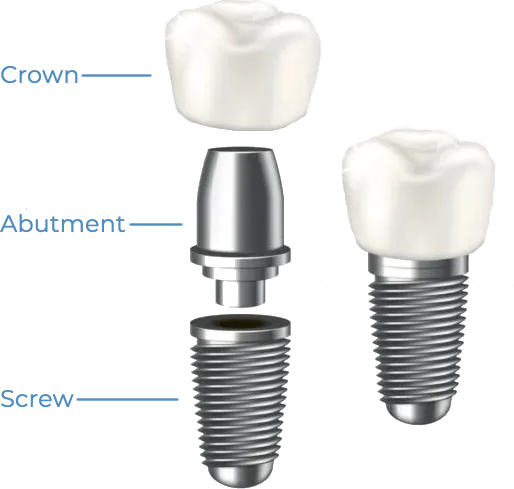
A single dental implant is ideal when one tooth is missing, and you want to replace it for aesthetics, comfort, and function. It requires one dental crown that connects to the implant screw.
- Implant-Supported Bridge
Implant-supported bridges are ideal for people with several missing teeth. The implant acts as an anchor for the bridge (instead of a natural tooth).
A fixed dental bridge restores function by preventing other teeth from moving. It also improves eating and speaking functions.
- All-on-4 Dental Implants
All-on-4 implants are recommended when a patient is looking for a secure solution for many missing teeth. This solution restores your entire upper or lower jaw (or both arches).
This is a permanent restoration. However, the overdenture can be removed for cleaning and dental exams.
- 3-on-6 Dental Implants
An alternative to an implant-retained denture is a 3-on-6 implant. It consists of three individual dental bridges attached to six dental implants.
Dental Implant Procedure: Step-By-Step
- 1. Remove the Tooth
If the damaged tooth is still in your mouth, the dentist will extract it. This step is not necessary if your tooth is already missing.
- 2. Grafting and Jawbone Preparation
Patients who undergo implant surgery may have thin or soft jawbones. In this case, bone grafting will be necessary.
It improves the quantity of bone and ensures the procedure doesn’t fail. The healing process for bone grafts takes a few months before a dental implant can be placed.
- 3. Implant Placement
During the actual procedure, the oral surgeon exposes the bone by cutting the gums.
An oral surgeon or periodontist drills holes into the bone. Then they position the implant (a post) deep into the bone, which functions as the tooth’s root.
If a front tooth is being restored, the dentist will fill the space with a temporary removable solution while the implant heals below the gums. If it is a back tooth, they will not place anything over it.
- 4. Healing and Growth
Osseointegration begins after the metal implant is placed in your jawbone. This is when the supporting bone begins to bond with the implant.
This process can take several months to complete and ensures the base is sturdy enough to support an artificial tooth (dental crown).
- 5. Abutment Placement (Crown Preparation)
After the healing process is complete, your dentist will place an abutment on top of the implant post.
The abutment extends the implant above the soft tissue (gums). This step allows for easy placement of the dental crown.
- 6. Crown Placement (Artificial Tooth)
Once the implant grows into the bone and is strong enough to support chewing, your dentist will make new impressions of your mouth.
A dental technician will create a custom dental crown in a lab. The dental crown looks similar to your natural teeth and sits on the abutment (connector). It becomes the only visible part of the implant.
- 7. Aftercare
Pain medications and antibiotics are usually prescribed post-op. It is important to only eat soft foods and practice excellent oral care habits during the healing process.
Restrict the intake of alcohol, caffeine, and tobacco to see the best results. Regular check-ups are necessary during the first few months after the procedure. You should also keep up with regular dental exams post-surgery.
At Our Clinic, we understand the impact of missing teeth on your oral health and self-confidence. Our dental implant solutions provide a long-lasting and natural-looking solution to restore your smile. Whether you require immediate or delayed implants, Dr. Alefiya Nalwala is dedicated to providing personalized care and ensuring optimal results. With our state-of-the-art technology and expertise in implant dentistry, we strive to deliver exceptional outcomes that enhance both your oral health and quality of life. Regain your smile and enjoy the benefits of a complete, functional set of teeth with our dental implant treatments. Contact us today to schedule a consultation and take the first step towards a confident and beautiful smile.